DI MATTEO Group supports AI-based optimisation of bucket elevators for alternative fuels
In cooperation with South Westphalia University of Applied Sciences, the DI MATTEO Group conducted a research project investigating how artificial intelligence (AI) can optimise the conveying behaviour of bucket elevators – particularly for alternative fuels.
Challenge: efficient conveying of alternative fuels
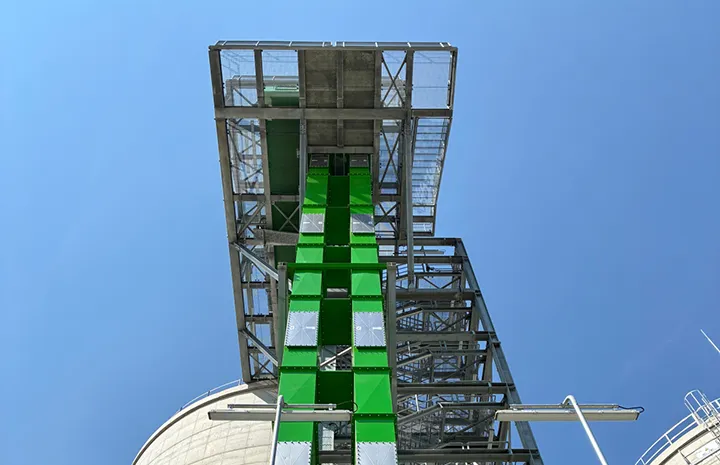
Alternative fuels such as refuse-derived fuels (RDF), biomass or wood chips are increasingly used in the cement and minerals industry to reduce CO₂ emissions and support more sustainable production processes. However, these materials place high demands on conveying systems: they feature irregular particle sizes, fluctuating bulk densities and inconsistent flow behaviour. In conventional bucket elevators, this can lead to issues such as:
unstable mass flow,
material losses due to overfilling or underfilling,
uneven filling of the buckets,
increased wear on buckets, belts and casings.
Research approach and results
As part of the project, digital twins, camera-based measurement methods and a reinforcement learning model were used. Reinforcement learning is a machine learning approach in which a system independently improves its decisions by continuously learning from feedback.
During a multi-stage test series, the AI system automatically adjusted relevant machine parameters – such as bucket elevator speed – based on observed material behaviour. A pilot test was conducted on a bucket elevator at the DI MATTEO Group’s test facility in Beckum.
The trials showed:
significantly improved bucket filling,
more stable discharge behaviour,
increased conveying capacity.
The results demonstrate that AI-supported process optimisation offers considerable potential – especially for bulk materials with highly variable properties, as is typical when handling alternative fuels.
Scientific collaboration
The publication in ZKG International was produced in collaboration with:
Prof. Dr. Dominik Aufderheide, Akshay Chavan, Prof. Dr. Alfons Noe, Tobias Rosenhövel (South Westphalia University of Applied Sciences, Soest)
Alexander Elbel and Benedikt Schmidt (DI MATTEO Group, Beckum)
The project illustrates how digital technologies – including AI, digital twins and intelligent sensor systems – can enhance the performance of established conveying technology while supporting sustainability goals in industry.